Thursday, September 19, 2013

Flu Vaccine Update: The 2013 Flu Shot


Somewhere in between hot summer weather turning to autumn, bright red leaves falling from trees, and snowflakes starting to fall, the fifth season of the year sets in — flu season.
Flu season officially starts in the late fall and continues into the early spring. And breaking out your sweaters and hanging up your Halloween decorations means it's time for your annual flu shot. Flu vaccines are already available at local pharmacies and drug stores and will make its way into clinics across the country. Here’s what you need to know about this year’s flu vaccine.

The 2013 Flu Vaccine

For the 2013-2014 flu season, there will be two vaccines: a trivalent vaccine that is made from three inactivated viruses researchers believe will be prevalent during flu season, and a quadrivalent vaccine containing four inactivated viruses.
According to the U.S. Centers for Disease Control and Prevention, the trivalent vaccine consists of these three flu strains:
  • an A/California/7/2009 (H1N1)pdm09-like virus;
  • an A(H3N2) virus antigenically like the cell-propagated prototype virus A/Victoria/361/2011;
  • a B/Massachusetts/2/2012-like virus.
For the quadrivalent vaccine, the CDC recommends it contain, “two influenza B viruses include the above three viruses and a B/Brisbane/60/2008-like virus.”
The quadrivalent vaccine will be in much shorter supply—vaccine manufacturers have projected they will make between 135 and 139 million doses of the flu shot for this season, and about 30 to 32 million of those will be the quadrivalent vaccine. Most of the the quadrivalent will be in the nasal spray form.
"The CDC has a very complicated way of mapping and tracking all these different viruses going around, and they try to predict which strains will be most rampant this year," says Kathryn Teng, MD, a physician in the department of internal medicine and director of clinical integration of personalized healthcare at the Cleveland Clinic in Ohio. They usually get it right, but not always.

Who Needs a Flu Shot?

Just because you got a seasonal flu shot last year doesn't mean you're off the hook this season. "The flu vaccine is different from year to year," says Dr. Teng, so that means it's a different vaccine every year. "Plus, the vaccine only lasts for a few months at a time.”
It takes two weeks after vaccination for antibodies to develop against the flu viruses, so people should not put off getting the shot.
Generally, anyone with a compromised immune system should protect themselves every flu season with a flu shot. This generally includes:
  • Pregnant women
  • The elderly
  • Anyone with a chronic condition like diabetes or asthma
  • Anyone taking medications that suppress the immune system
  • Anyone with HIV or AIDS
People who live or work around chronically ill people (such as in a nursing facility or hospital) should also get vaccinated to protect themselves. All children over the age of 6 months old, as well as teenagers, should get the flu vaccine each year.
There are four different types of flu vaccine available:
  • The regular shot approved for those 6 months and older.
  • A high-dose shot approved for those 65 years and older.
  • An intradermal shot approved for those 18 to 64 years old, a vaccine where the needle only goes into the skin, not the muscle.
  • A nasal-spray vaccine, made with a live, weakened virus given as a nasal spray, is approved for those 2 to 49 years old who are in good health. The CDC notes this vaccine does not cause the flu.

If I Get the Shot, Can I Get the Flu?

Even if you get your recommended flu vaccine, you may still get sick.
It's important to understand that the flu shot has its limits as to how well it can protect you, and that it may not be able to completely shield you from getting a strain of the flu. But that doesn't mean that it's not still important to your health for you to get a flu shot — especially if you're at a high risk for developing severe complications of the flu.
If you get a flu shot and still end up getting sick with the flu, there's a benefit. "It [the flu vaccine] makes it less severe," says Teng. So you'll have less debilitating symptoms and be back on your feet faster than you would if you hadn't gotten your flu shot.
Of course, frequent hand washing and avoiding contact with sick people are also important in warding off the flu. But this year's combined flu shot should make protecting yourself just a little less painful, with only one needlestick to go through.

Ten Things You Need to Know Today


Emmy Awards - Arrivals
Your daily look at late-breaking news, upcoming events and the stories that will be talked about today:
1. STOCKS HIT RECORD AFTER FED KEEPS STIMULUS IN PLACE
Wall Street cheers the Federal Reserve's decision to maintain its $85 billion-a-month bond-buying program.
2. NAVY YARD GUNMAN GAVE NO CLEAR WARNING
During two hospital visits in the weeks before the rampage, Aaron Alexis complained of insomnia – but denied having any thoughts of harming himself or others, officials say.
3. FLASHPOINT IN ATTEMPT TO SCUTTLE OBAMACARE
A fight looms in Congress over conservatives' efforts to yank the funding from Obama's health care overhaul.
4. WHERE AN ISLAMIST STRONGHOLD IS UNDER SEIGE
Egyptian security forces encircle a town near Cairo that was the scene last month of an attack by suspected Morsi supporters that left 15 police officers dead.
5. ASSAD ARGUES HIS CASE
The Syrian dictator insists in a TV interview that terrorists, not his regime, were to blame for last month's deadly chemical weapons attack.
6. HOW HIGHER EDUCATION HAS BEEN TRANSFORMED IN AFGHANISTAN
Since the U.S.-led invasion in 2001, the number of college students in the country has soared 26-fold to almost 204,000 – as many as a fifth of them women.
7. MANUEL MUSCLES UP
The tropical storm that devastated Acapulco over the weekend strengthens into a hurricane and takes fresh aim at Mexico's northwestern coast.
8. WHY OBESE PEOPLE ARE LESS LIKELY TO SURVIVE CANCER
One reason may be that doctors often short them on chemotherapy by not basing the dose on size.
9. AND THE WINNER IS...
The AP's Lynn Elber predicts "House of Cards" will earn the Emmy on Sunday for best drama. Fellow AP critic Frazier Moore says it'll be "Breaking Bad."
10. EX-HEAVYWEIGHT CHAMP DIES AT 70
Ken Norton was best known for defeating Muhammad Ali, breaking Ali's jaw and sending him to the hospital in a bout in 1973.

Ken Norton Dead: Former Muhammad Ali Rival, Heavyweight Boxing Champion Dies At 70

 
ken norton dead
LAS VEGAS — He was the second man to beat Muhammad Ali, breaking Ali's jaw and sending him to the hospital in their 1973 heavyweight fight.
Ken Norton frustrated Ali three times in all, including their final bout at Yankee Stadium where he was sure he had beaten him once again.
Norton, who died Wednesday at the age of 70, lost that fight for the heavyweight title. But he was forever linked to Ali for the 39 rounds they fought over three fights, with very little separating one man from the other in the ring.
"Kenny was a good, good fighter. He beat a lot of guys," said Ed Schuyler Jr., who covered many of Norton's fights for The Associated Press. "He gave Ali fits because Ali let him fight coming forward instead of making him back up."
Norton is the only heavyweight champion never to win the title in the ring, and boxing fans still talk about the bruising battle he waged with Larry Holmes for the title in 1978. But it was his first fight with Ali that made the former Marine a big name and the two fights that followed that were his real legacy.
Few gave Norton, who possessed a muscular, sculpted body, much of a chance against Ali in their first meeting, held at the Sports Arena in San Diego, where Norton lived. But his awkward style and close-in pressing tactics confused Ali, who fought in pain after his jaw was broken.
"Ali tore up his ankle while training and we were going to call the fight off but didn't," former Ali business manager Gene Kilroy said. "Ali said it's not going to be that tough."
It was, with Norton breaking Ali's jaw in the early rounds and having his way with the former champion for much of the night. The loss was even more shocking because Ali had only lost to Joe Frazier in their 1971 showdown and was campaigning for the title he would win again the next year against George Foreman in Zaire.
"Norton was unorthodox," Kilroy said. "Instead of jabbing from above like most fighters he would put his hand down and jab up at Ali."
Kilroy said after the fight Norton visited Ali at the hospital where he was getting his broken jaw wired. Ali, he said, told him he was a great fighter and he never wanted to fight him again.
Ken Norton Jr., a coach with the Seattle Seahawks, confirmed his father's death to The Associated Press before handing the phone to his wife, too distraught to talk.
Norton had been in poor health for the last several years after suffering a series of strokes, Kilroy said.
"He's been fighting the battle for two years," he said. "I'm sure he's in heaven now with all the great fighters. I'd like to hear that conversation."
Norton didn't have long to celebrate his big win over Ali. They fought six months later, and Ali won a split decision.
They met for a third time on Sept. 28, 1976, at Yankee Stadium and Ali narrowly won to keep his heavyweight title.
Norton would come back the next year to win a heavyweight title eliminator and was declared champion by the World Boxing Council when Leon Spinks decided to fight Ali in a rematch instead of facing his mandatory challenger. But on June 9, 1978, he lost a brutal 15-round fight to Holmes in what many regard as one of boxing's epic heavyweight bouts and would never be champion again.
Norton finished with a record of 42-7-1 and 33 knockouts. He would later embark on an acting career, appearing in several movies, and was a commentator at fights.
Former heavyweight champion Mike Tyson, who visited Norton at the veteran's hospital in the Las Vegas suburb of Henderson, tweeted: "Ken Norton was always nice to me even when I was just an amateur fighter. He always treated me like I was somebody. Remarkable man."
Ken Norton Jr. was a linebacker for 13 years in the NFL, playing for Dallas and San Francisco, and coaches the position for the Seahawks. He and his father were estranged for a time in the 1990s before finally reconciling.
Norton always gave his father credit for his career, saying he learned how to train hard by watching him go for early morning runs when he was a child.
"It's been noted that my father and I are on speaking terms and everything's back together now," Norton Jr. said in 1995. "It's part of what I do. No matter what I do, I can't get away from boxing."
Norton, born Aug. 9, 1943, in Jacksonville, Ill., started boxing when he was in the Marines, and began his pro career after his release from duty in 1967. He lost only once in his early fights but had fought few fighters of any note when he was selected to meet Ali.
At the time, Ali was campaigning to try to win back the heavyweight crown he lost to Joe Frazier in 1973.
After that bruising first bout, they faced off two more times, including the final fight at Yankee Stadium on a night when police were on strike and many in the crowd feared for their safety. The fight went 15 rounds and Ali won a decision.
Kilroy said Ali and Norton never had any animosity toward each other and became good friends over the years. Still, Norton always thought he had won all three fights.
Norton would come back in 1977 to win an eliminator against Jimmy Young and was declared champion by the WBC when Spinks was stripped of the title.
His fight against Holmes in 1978 at Caesars Palace was his last big hurrah, with the two heavyweights going back and forth, trading huge blows inside a steamy pavilion in the hotel's back lot. The fight was still up for grabs in the 15th round and both fighters reached inside themselves to deliver one of the more memorable final rounds in heavyweight history.
When the decision was announced, two ringside judges favored Holmes by one point while the third favored Norton by a point.
Norton was badly injured in a near fatal car accident in 1986. He recovered but never regained his full physical mobility.
"The doctors said I would never walk or talk," Norton said at an autograph session in 2011 in Las Vegas, lifting his trademark fedora to show long surgical scars on his bald head.
Kilroy said Norton was visited at the hospital by former fighters, including Tyson, Earnie Shavers and Thomas Hearns.
Norton fought only five more times after losing his title to Holmes. His final fight came Nov. 5, 1981, when he was knocked out in the first round by Gerry Cooney at Madison Square Garden.
Information on services and other survivors was not immediately released by the family.

Winning Powerball Numbers For September 18 Drawing: 7, 10, 22, 32, 35 And 19

news

The winning Powerball numbers for September 18 are 7, 10, 22, 32, 35 and the Powerball number is 19.
According to the Powerball website, there was one winning ticket sold in South Carolina for the $399,400,000 grand prize.
Wednesday's jackpot was the fourth-largest prize in the lottery's history and the fifth-largest of any U.S. lottery, the Multi-State Lottery Association said.
Powerball is played in 43 states, Washington and the U.S. Virgin Islands.
The odds of winning the Powerball lottery jackpot are 1 in 175,223,510.

Wednesday, September 18, 2013

Divorce, Money Problems Fueled Robin Williams's Return to TV

Robin Williams
Former wild man Robin Williams is returning to the small screen on September 26 in "The Crazy Ones," with Sarah Michelle Gellar. He recently sat down with Parade to talk frankly about why he wanted to return to TV, his stint rehab, and more.

Williams hasn't regularly appeared on a television show since he won us over as Mork from Ork in "Mork & Mindy." In addition to the appeal of a program created by TV vet David E. Kelley, he told Parade that part of the show's appeal was "having a steady job," adding, "I have two [other] choices: go on the road doing stand-up, or do small, independent movies working almost for scale [minimum union pay]. The movies are good, but a lot of times they don't even have distribution. There are bills to pay. My life has downsized, in a good way. I'm selling the ranch up in Napa. I just can't afford it anymore."

Another thing he can't afford? One more divorce. When asked if he'd lost all his money to his exes, Williams admitted that his failed marriages have taken a sizable chunk out of his bank account. "Well, not all. Lost enough," he told the magazine. "Divorce is expensive. I used to joke they were going to call it 'all the money,' but they changed it to 'alimony.' It's ripping your heart out through your wallet. Are things good with my exes? Yes. But do I need that lifestyle? No."

Williams also discussed relapsing on alcohol and his family's intervention in 2006. In an outtake from the interview, he discussed attending Alcoholics Anonymous, saying, "I felt so good about the first AA meeting I attended that I went out and drank the next day." He was persuaded to come back after a friend encouraged him, saying, "Hey, we don't shoot our wounded. Come back."

Read the rest of this interview in "Parade" when it hits stands this weekend.

Long Lives, Poor Health — Can We Have One Without the Other?

Long lives, poor health

For most of human history, old people were rare. A lucky few might make it to 60 or 70, but most people died before their hair turned white and their faces sagged. It wasn’t until the 20th century that the average lifespan reached 50.
Today, we live what our ancestors would have considered two lives. At forty, we are still looking forward and planning for decades of productive life.
But those extra years come at a cost. A study published in the Journal of the American Medical Association found that our ‘second lives’ are burdened with chronic illnesses including depression, back pain, diabetes, and asthma.
“It turns out we’re living longer but we will spend more years with chronic disabilities,” said Christopher Murray, MD, of the University of Washington, who co-authored the study.
Dr. Murray and his team examined the major causes of poor health and premature death in the United States over the past 20 years.
Much of our poor health is the result of bad choices with diet at the top of the list, leading to 680,000 premature deaths, according to the study.

Saturday, September 14, 2013

Cota By Ossia Aims To Drive A Wireless Power Revolution And Change How We Think About Charging


Cota By Ossia Aims To Drive A Wireless Power Revolution And Change How We Think About Charging

Darrell Etherington

Monday, September 9th, 2013

Ossia Cota Technology
Wireless power. It’s less sci-fi sounding than it once was, thanks to induction charging like that based on the Qi standard, but that’s still a tech that essentially requires contact, if not incredibly close proximity. Magnetic resonance is another means to achieve wireless power, and perfect for much higher-demand applications, like charging cars. But there’s been very little work done in terms of building a solution that can power your everyday devices in a way that doesn’t require thought or changing the way we use our devices dramatically.
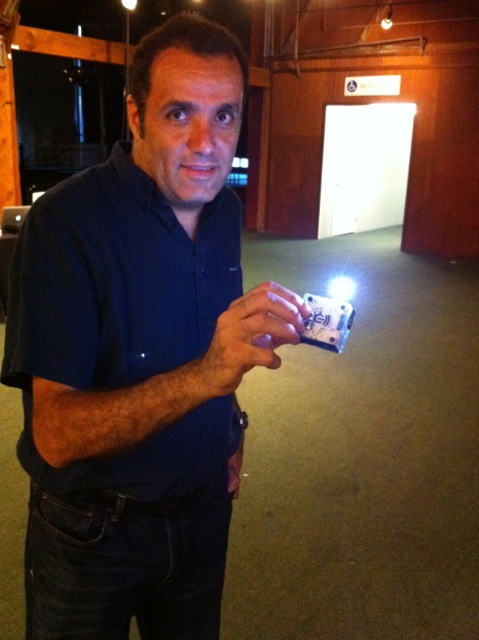
That’s where Cota by Ossia comes in. The startup is the brainchild of physicist Hatem Zeine, who decided to focus on delivering wireless power in a way that was commercially viable, both for large-scale industrial applications and for consumer use. Zeine has been hard at work developing his wireless power technology and refining its delivery for over a decade now, and has built Ossia under wraps, managing to raise an impressive $3.2 million along the way while also keeping the startup almost completely invisible to the outside world.
Today, however, Zeine is ready to show what Ossia can do, and he’s presenting the first public demo of the Cota wireless charging prototype on-stage at Disrupt and revealing his company Ossia publicly for the first time. Despite the fact that no one’s heard of Ossia, the Cota prototype in its current form already managed to deliver power wirelessly to devices over distances of around 10 feet, delivering around 10 percent of the total original source power to recipient devices using the same unlicensed spectrum that powers Wi-Fi, Bluetooth, Zigbee and other wireless communication standards.
“I got fascinated by electromagnetic radiation, the way that light and optics and radio waves are the same thing,” Zeine said, explaining how he got interested in the subject while studying physics as a student. “And I got thinking about ‘what can you really do beyond this?’ there is something about the linearity of physics and the non-linearity of physics. most people are familiar with the linear version, which is the common sense version, where two apples are twice the weight of one, for instance.”
“In wave theory and electromagnetic systems, you don’t get linearities everywhere,” he added, describing the science behind Cota. “There are situations where double could mean for more, like double could mean square, or 3 plus 3 apples could result in a net total of 9 apples, so to speak. When you move from the linear version to the power version, things happen that were quite surprising.”

I was always thinking, “What’s the catch?”

Zeine started doing computer simulations to figure out what he was on to, but says unlike Thomas Edison, for example, who started with a problem and tried to solve it but came up with many failures before success, he started out with a solution and found many problems that it does solve, including questions around health, safety, interference with other wireless signals, delivering power to multiple devices, non-line of site, around and behind walls and more. “I was always thinking ‘What’s the catch?’,” he said, “But sometimes an invention just solves the problem and goes all the way. This was one of them, we had something here that was much, much different than what people expect.”
When Zeine then decided to turn Cota’s wireless charging into a company, he faced understandable and considerable skepticism. Naysayers suggested he couldn’t deliver wireless power safely, or with adequate efficiency to be useful, or consistently, or any number of objections you yourself are probably cycling through at this moment. Skepticism aside, Zeine stuck to his guns and set about commercializing his discovery. In 2007, Zeine filed his first patent for the tech, formed Ossia in 2008 and continued to file patents, and he says now the company has a much deeper understanding of how it works. They’ve built the prototype they’re demoing on stage, and have another in the works to debut later this year.
“What we’re doing uses the same frequencies as Wi-Fi,” he explained. “It’s the unlicensed spectrum that’s used by Wi-Fi, and many phones, Bluetooth and Zigbee devices and so on in our lives. The nice thing about this frequency is that it’s just the sweet spot for our technology for distance, safety, for the size of the antennas and the hardware that we use, it’s just a perfect level. Also it’s well understood, since people have had Wi-Fi in their homes for a long time now.”
Cota demo LEDsObviously health and safety is going to be a foreground concern when it comes to new wireless tech of any kind, but something that’s designed to be able to provide enough energy to power up devices will definitely raise eyebrows. Aside from being at a late stage in terms of gaining FCC clearance, Zeine says Ossia also benefits from using the same kind of spectrum that Wi-Fi broadcasts at, and says Cota offers the same kind of health risks that Wi-Fi in-home does. Academic research on how much that actually is may differ, but consumers definitely seem willing to accept the risks associated with Wi-Fi, Bluetooth and other similar specifications.
“Cota is the only wireless power technology that can deliver one watt of power at a distance of 30 ft safely,” Zeine said on stage today at Disrupt, highlighting range as well as health and safety. During his presentation, Zeine showed an iPhone 5 being charged remotely from his version one prototype wireless power transmitter, which was greeted by plenty of applause from those in attendance.
The next step for Cota is delivering a commercial-grade product capable of replacing the numerous wired power connections for sensors and monitors in sensitive facilities like oil and gas refineries with wirelessly powered devices, which decreases risk by minimizing the number of potential opportunities there are for generating sparks, since there are fewer live cables lying around. Commercialized versions should be ready to ship in the next couple of months, Zeine says, with consumerized versions following in 2015. Neither would’ve been possible in terms of cost alone 20 years ago, he adds, but advances in the tech of Cota system components have made it possible to do with thousands what would once have cost millions.
Long-term, the vision of Zeine and Ossia is one where you’re never out of wireless charging range – charging networks spanning home, public spaces and offices would make it possible to build devices like phones and remotes with only small batteries, that are constantly topped off and that never need to be plugged in. He says the aim is not just to disrupt the battery, but eventually even to eliminate the concept of “charging” as a conscious act altogether.

Question & Answer From Disrupt Judges

1. Do you want to license your tech to OEMs?
A: Cota will provide licensing of patents, hardware designs, and also its own hardware and patent licensing.
2. What is the cost of this for consumers, and size of household device?
A: The Cota will be over $100, and be about the size of a large tower PC once consumerized.
3. Can the transmitter be smaller?
A: The size of the current device is due to using off-the-shelf parts, so it can be reduced tremendously using custom parts.
4. Does it require line-of-sight?
A: No, it can go around walls and through walls just like a Wi-Fi signal.
5. Is there some sort of identification, can a device take power from a system unauthorized?
A: You can configure the system to recognize only a specific set of devices, or open if you want to power all Cota-tech enabled devices.