Thursday, September 19, 2013

Ken Norton Dead: Former Muhammad Ali Rival, Heavyweight Boxing Champion Dies At 70

 
ken norton dead
LAS VEGAS — He was the second man to beat Muhammad Ali, breaking Ali's jaw and sending him to the hospital in their 1973 heavyweight fight.
Ken Norton frustrated Ali three times in all, including their final bout at Yankee Stadium where he was sure he had beaten him once again.
Norton, who died Wednesday at the age of 70, lost that fight for the heavyweight title. But he was forever linked to Ali for the 39 rounds they fought over three fights, with very little separating one man from the other in the ring.
"Kenny was a good, good fighter. He beat a lot of guys," said Ed Schuyler Jr., who covered many of Norton's fights for The Associated Press. "He gave Ali fits because Ali let him fight coming forward instead of making him back up."
Norton is the only heavyweight champion never to win the title in the ring, and boxing fans still talk about the bruising battle he waged with Larry Holmes for the title in 1978. But it was his first fight with Ali that made the former Marine a big name and the two fights that followed that were his real legacy.
Few gave Norton, who possessed a muscular, sculpted body, much of a chance against Ali in their first meeting, held at the Sports Arena in San Diego, where Norton lived. But his awkward style and close-in pressing tactics confused Ali, who fought in pain after his jaw was broken.
"Ali tore up his ankle while training and we were going to call the fight off but didn't," former Ali business manager Gene Kilroy said. "Ali said it's not going to be that tough."
It was, with Norton breaking Ali's jaw in the early rounds and having his way with the former champion for much of the night. The loss was even more shocking because Ali had only lost to Joe Frazier in their 1971 showdown and was campaigning for the title he would win again the next year against George Foreman in Zaire.
"Norton was unorthodox," Kilroy said. "Instead of jabbing from above like most fighters he would put his hand down and jab up at Ali."
Kilroy said after the fight Norton visited Ali at the hospital where he was getting his broken jaw wired. Ali, he said, told him he was a great fighter and he never wanted to fight him again.
Ken Norton Jr., a coach with the Seattle Seahawks, confirmed his father's death to The Associated Press before handing the phone to his wife, too distraught to talk.
Norton had been in poor health for the last several years after suffering a series of strokes, Kilroy said.
"He's been fighting the battle for two years," he said. "I'm sure he's in heaven now with all the great fighters. I'd like to hear that conversation."
Norton didn't have long to celebrate his big win over Ali. They fought six months later, and Ali won a split decision.
They met for a third time on Sept. 28, 1976, at Yankee Stadium and Ali narrowly won to keep his heavyweight title.
Norton would come back the next year to win a heavyweight title eliminator and was declared champion by the World Boxing Council when Leon Spinks decided to fight Ali in a rematch instead of facing his mandatory challenger. But on June 9, 1978, he lost a brutal 15-round fight to Holmes in what many regard as one of boxing's epic heavyweight bouts and would never be champion again.
Norton finished with a record of 42-7-1 and 33 knockouts. He would later embark on an acting career, appearing in several movies, and was a commentator at fights.
Former heavyweight champion Mike Tyson, who visited Norton at the veteran's hospital in the Las Vegas suburb of Henderson, tweeted: "Ken Norton was always nice to me even when I was just an amateur fighter. He always treated me like I was somebody. Remarkable man."
Ken Norton Jr. was a linebacker for 13 years in the NFL, playing for Dallas and San Francisco, and coaches the position for the Seahawks. He and his father were estranged for a time in the 1990s before finally reconciling.
Norton always gave his father credit for his career, saying he learned how to train hard by watching him go for early morning runs when he was a child.
"It's been noted that my father and I are on speaking terms and everything's back together now," Norton Jr. said in 1995. "It's part of what I do. No matter what I do, I can't get away from boxing."
Norton, born Aug. 9, 1943, in Jacksonville, Ill., started boxing when he was in the Marines, and began his pro career after his release from duty in 1967. He lost only once in his early fights but had fought few fighters of any note when he was selected to meet Ali.
At the time, Ali was campaigning to try to win back the heavyweight crown he lost to Joe Frazier in 1973.
After that bruising first bout, they faced off two more times, including the final fight at Yankee Stadium on a night when police were on strike and many in the crowd feared for their safety. The fight went 15 rounds and Ali won a decision.
Kilroy said Ali and Norton never had any animosity toward each other and became good friends over the years. Still, Norton always thought he had won all three fights.
Norton would come back in 1977 to win an eliminator against Jimmy Young and was declared champion by the WBC when Spinks was stripped of the title.
His fight against Holmes in 1978 at Caesars Palace was his last big hurrah, with the two heavyweights going back and forth, trading huge blows inside a steamy pavilion in the hotel's back lot. The fight was still up for grabs in the 15th round and both fighters reached inside themselves to deliver one of the more memorable final rounds in heavyweight history.
When the decision was announced, two ringside judges favored Holmes by one point while the third favored Norton by a point.
Norton was badly injured in a near fatal car accident in 1986. He recovered but never regained his full physical mobility.
"The doctors said I would never walk or talk," Norton said at an autograph session in 2011 in Las Vegas, lifting his trademark fedora to show long surgical scars on his bald head.
Kilroy said Norton was visited at the hospital by former fighters, including Tyson, Earnie Shavers and Thomas Hearns.
Norton fought only five more times after losing his title to Holmes. His final fight came Nov. 5, 1981, when he was knocked out in the first round by Gerry Cooney at Madison Square Garden.
Information on services and other survivors was not immediately released by the family.

Winning Powerball Numbers For September 18 Drawing: 7, 10, 22, 32, 35 And 19

news

The winning Powerball numbers for September 18 are 7, 10, 22, 32, 35 and the Powerball number is 19.
According to the Powerball website, there was one winning ticket sold in South Carolina for the $399,400,000 grand prize.
Wednesday's jackpot was the fourth-largest prize in the lottery's history and the fifth-largest of any U.S. lottery, the Multi-State Lottery Association said.
Powerball is played in 43 states, Washington and the U.S. Virgin Islands.
The odds of winning the Powerball lottery jackpot are 1 in 175,223,510.

Wednesday, September 18, 2013

Divorce, Money Problems Fueled Robin Williams's Return to TV

Robin Williams
Former wild man Robin Williams is returning to the small screen on September 26 in "The Crazy Ones," with Sarah Michelle Gellar. He recently sat down with Parade to talk frankly about why he wanted to return to TV, his stint rehab, and more.

Williams hasn't regularly appeared on a television show since he won us over as Mork from Ork in "Mork & Mindy." In addition to the appeal of a program created by TV vet David E. Kelley, he told Parade that part of the show's appeal was "having a steady job," adding, "I have two [other] choices: go on the road doing stand-up, or do small, independent movies working almost for scale [minimum union pay]. The movies are good, but a lot of times they don't even have distribution. There are bills to pay. My life has downsized, in a good way. I'm selling the ranch up in Napa. I just can't afford it anymore."

Another thing he can't afford? One more divorce. When asked if he'd lost all his money to his exes, Williams admitted that his failed marriages have taken a sizable chunk out of his bank account. "Well, not all. Lost enough," he told the magazine. "Divorce is expensive. I used to joke they were going to call it 'all the money,' but they changed it to 'alimony.' It's ripping your heart out through your wallet. Are things good with my exes? Yes. But do I need that lifestyle? No."

Williams also discussed relapsing on alcohol and his family's intervention in 2006. In an outtake from the interview, he discussed attending Alcoholics Anonymous, saying, "I felt so good about the first AA meeting I attended that I went out and drank the next day." He was persuaded to come back after a friend encouraged him, saying, "Hey, we don't shoot our wounded. Come back."

Read the rest of this interview in "Parade" when it hits stands this weekend.

Long Lives, Poor Health — Can We Have One Without the Other?

Long lives, poor health

For most of human history, old people were rare. A lucky few might make it to 60 or 70, but most people died before their hair turned white and their faces sagged. It wasn’t until the 20th century that the average lifespan reached 50.
Today, we live what our ancestors would have considered two lives. At forty, we are still looking forward and planning for decades of productive life.
But those extra years come at a cost. A study published in the Journal of the American Medical Association found that our ‘second lives’ are burdened with chronic illnesses including depression, back pain, diabetes, and asthma.
“It turns out we’re living longer but we will spend more years with chronic disabilities,” said Christopher Murray, MD, of the University of Washington, who co-authored the study.
Dr. Murray and his team examined the major causes of poor health and premature death in the United States over the past 20 years.
Much of our poor health is the result of bad choices with diet at the top of the list, leading to 680,000 premature deaths, according to the study.

Saturday, September 14, 2013

Cota By Ossia Aims To Drive A Wireless Power Revolution And Change How We Think About Charging


Cota By Ossia Aims To Drive A Wireless Power Revolution And Change How We Think About Charging

Darrell Etherington

Monday, September 9th, 2013

Ossia Cota Technology
Wireless power. It’s less sci-fi sounding than it once was, thanks to induction charging like that based on the Qi standard, but that’s still a tech that essentially requires contact, if not incredibly close proximity. Magnetic resonance is another means to achieve wireless power, and perfect for much higher-demand applications, like charging cars. But there’s been very little work done in terms of building a solution that can power your everyday devices in a way that doesn’t require thought or changing the way we use our devices dramatically.
That’s where Cota by Ossia comes in. The startup is the brainchild of physicist Hatem Zeine, who decided to focus on delivering wireless power in a way that was commercially viable, both for large-scale industrial applications and for consumer use. Zeine has been hard at work developing his wireless power technology and refining its delivery for over a decade now, and has built Ossia under wraps, managing to raise an impressive $3.2 million along the way while also keeping the startup almost completely invisible to the outside world.
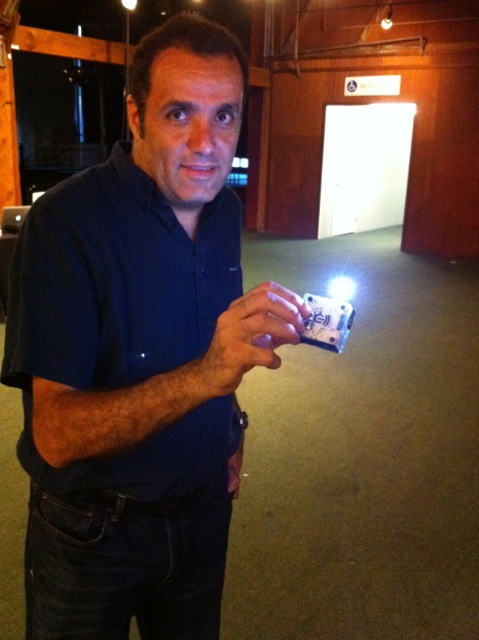
Today, however, Zeine is ready to show what Ossia can do, and he’s presenting the first public demo of the Cota wireless charging prototype on-stage at Disrupt and revealing his company Ossia publicly for the first time. Despite the fact that no one’s heard of Ossia, the Cota prototype in its current form already managed to deliver power wirelessly to devices over distances of around 10 feet, delivering around 10 percent of the total original source power to recipient devices using the same unlicensed spectrum that powers Wi-Fi, Bluetooth, Zigbee and other wireless communication standards.
“I got fascinated by electromagnetic radiation, the way that light and optics and radio waves are the same thing,” Zeine said, explaining how he got interested in the subject while studying physics as a student. “And I got thinking about ‘what can you really do beyond this?’ there is something about the linearity of physics and the non-linearity of physics. most people are familiar with the linear version, which is the common sense version, where two apples are twice the weight of one, for instance.”
“In wave theory and electromagnetic systems, you don’t get linearities everywhere,” he added, describing the science behind Cota. “There are situations where double could mean for more, like double could mean square, or 3 plus 3 apples could result in a net total of 9 apples, so to speak. When you move from the linear version to the power version, things happen that were quite surprising.”

I was always thinking, “What’s the catch?”

Zeine started doing computer simulations to figure out what he was on to, but says unlike Thomas Edison, for example, who started with a problem and tried to solve it but came up with many failures before success, he started out with a solution and found many problems that it does solve, including questions around health, safety, interference with other wireless signals, delivering power to multiple devices, non-line of site, around and behind walls and more. “I was always thinking ‘What’s the catch?’,” he said, “But sometimes an invention just solves the problem and goes all the way. This was one of them, we had something here that was much, much different than what people expect.”
When Zeine then decided to turn Cota’s wireless charging into a company, he faced understandable and considerable skepticism. Naysayers suggested he couldn’t deliver wireless power safely, or with adequate efficiency to be useful, or consistently, or any number of objections you yourself are probably cycling through at this moment. Skepticism aside, Zeine stuck to his guns and set about commercializing his discovery. In 2007, Zeine filed his first patent for the tech, formed Ossia in 2008 and continued to file patents, and he says now the company has a much deeper understanding of how it works. They’ve built the prototype they’re demoing on stage, and have another in the works to debut later this year.
“What we’re doing uses the same frequencies as Wi-Fi,” he explained. “It’s the unlicensed spectrum that’s used by Wi-Fi, and many phones, Bluetooth and Zigbee devices and so on in our lives. The nice thing about this frequency is that it’s just the sweet spot for our technology for distance, safety, for the size of the antennas and the hardware that we use, it’s just a perfect level. Also it’s well understood, since people have had Wi-Fi in their homes for a long time now.”
Cota demo LEDsObviously health and safety is going to be a foreground concern when it comes to new wireless tech of any kind, but something that’s designed to be able to provide enough energy to power up devices will definitely raise eyebrows. Aside from being at a late stage in terms of gaining FCC clearance, Zeine says Ossia also benefits from using the same kind of spectrum that Wi-Fi broadcasts at, and says Cota offers the same kind of health risks that Wi-Fi in-home does. Academic research on how much that actually is may differ, but consumers definitely seem willing to accept the risks associated with Wi-Fi, Bluetooth and other similar specifications.
“Cota is the only wireless power technology that can deliver one watt of power at a distance of 30 ft safely,” Zeine said on stage today at Disrupt, highlighting range as well as health and safety. During his presentation, Zeine showed an iPhone 5 being charged remotely from his version one prototype wireless power transmitter, which was greeted by plenty of applause from those in attendance.
The next step for Cota is delivering a commercial-grade product capable of replacing the numerous wired power connections for sensors and monitors in sensitive facilities like oil and gas refineries with wirelessly powered devices, which decreases risk by minimizing the number of potential opportunities there are for generating sparks, since there are fewer live cables lying around. Commercialized versions should be ready to ship in the next couple of months, Zeine says, with consumerized versions following in 2015. Neither would’ve been possible in terms of cost alone 20 years ago, he adds, but advances in the tech of Cota system components have made it possible to do with thousands what would once have cost millions.
Long-term, the vision of Zeine and Ossia is one where you’re never out of wireless charging range – charging networks spanning home, public spaces and offices would make it possible to build devices like phones and remotes with only small batteries, that are constantly topped off and that never need to be plugged in. He says the aim is not just to disrupt the battery, but eventually even to eliminate the concept of “charging” as a conscious act altogether.

Question & Answer From Disrupt Judges

1. Do you want to license your tech to OEMs?
A: Cota will provide licensing of patents, hardware designs, and also its own hardware and patent licensing.
2. What is the cost of this for consumers, and size of household device?
A: The Cota will be over $100, and be about the size of a large tower PC once consumerized.
3. Can the transmitter be smaller?
A: The size of the current device is due to using off-the-shelf parts, so it can be reduced tremendously using custom parts.
4. Does it require line-of-sight?
A: No, it can go around walls and through walls just like a Wi-Fi signal.
5. Is there some sort of identification, can a device take power from a system unauthorized?
A: You can configure the system to recognize only a specific set of devices, or open if you want to power all Cota-tech enabled devices.

Mac And Cheese Mistakes You Might Be Making


You know what's great? Mac and cheese. You know what's better? Homemade mac and cheese. You know what's the worst? When you spend time, money, mental and emotional effort on cooking something that you don't like in the end.
Macaroni and cheese can be especially frustrating to mess up because we're usually making it in large batches, with lots of cheese, and that is not a melted cheese opportunity you want to squander. Let's get through this together, and discuss some of the mac and cheese mistakes you might be making.
  • 1
    Not Making Your Own Because It Seems Hard/Time-Consuming
    mtlabor/Food52
    Mac and cheese is so delicious that a lot of people think it must be hard to make. There are so many different ways to approach it that you could spend all day on it, or you could spend 45 minutes and do it all in one pot. Once you make homemade mac and cheese once, you will realize that you make the best mac and cheese ever. Get the Lobster Mac n Cheese recipe from Food52
  • 2
    Not Using Enough Cheese
    Flickr: ilovememphis
    As the name indicates, there are two ingredients that are important in this dish: the macaroni and the cheese. Mac and cheese should either be creamy or stringy because of the cheese. Cheese should coat the noodles. This is a cheese-heavy dish. Don't eat it every day, but when you do eat it, eat it right. Our rule of thumb is to always grate more cheese than we think we'll need. Even if you've shredded too much, you can save it for another use.
  • 3
    Using Any Pasta But Elbows Or Shells
    Flickr: megan.chromik
    The amazing thing about pasta is that certain shapes are designed for certain applications. Macaroni elbows and shells are designed to hold thick, creamy sauces. Cheese sauce is too heavy for a lot of pastas, making them either limp and flabby or clumped and unmanageable. Stick to the classics on this one.
  • 4
    Overcooking Your Pasta
    Flickr: EvelynGiggles
    Whether you are a stovetop mac and cheese maker or an oven-baked mac and cheese maker, there is one universal truth in mac and cheesery: you're going to have to cook those noodles twice. When you do the initial boil on your pasta, cook it to just under al dente, so that there's a still plenty of chew on the noodles. Then you won't eat flabby macaroni covered in delicious cheese.
  • 5
    Adding Too Much Liquid
    Flickr: Rex Roof
    You want your mac and cheese to be creamy, but you do not want to make mac and cheese soup (well maybe you do, but we don't). Add your liquids a bit at a time, stir to incorporate, then see where you stand. You can always add more, taking away is significantly more complex.
  • 6
    Not Browning The Top A Little
    Flickr: technochick
    Look at this. This is like the surface of a beautiful cheese planet. When you make your own mac and cheese, whether you are a proponent of topping with breadcrumbs or not, you get the opportunity to turn your oven on to broil, then watch very closely as the top bubbles and browns. Don't squander this cheese opportunity.
  • 7
    Trying To Replicate The Boxed Stuff
    Imgur
    The stuff in the box? Unquestionably delicious. But it's not mac and cheese, it's something else. Instead of trying to replicate it, make gooey, creamy, homestyle mac and cheese that you can't get anywhere else.
  • 8
    Using Velveeta
    Flickr: Charles Williams
    No, guys. This is not cheese. There is one appropriate culinary use for Velveeta occasionally and that is queso. Keep it away from your noodles.
  • 9
    Using Really Fancy Cheese
    Flickr: daskerst
    Guys, this isn't worth it. Do not melt a $14 hunk of Ossau Iraty into your mac and cheese. If the mac and cheese you love contains fontina, asiago, parmesan and provolone -- fine, whatever, it will never beat cheddar and monterey jack. You want a mild cheese for creaminess, a sharp cheese for tang. Keep it simple, keep it relatively inexpensive, save the fancy stuff for the cheese plate.
  • 10
    Getting Avocado Into The Mix
    Imgur
    We love avocado. We love mac and cheese. There are some ingredients that just do not need to mix. Let's stop this insanity.
  • 11
    Using Truffle Oil
    Flickr: C John Thompson
    Okay, guys. Real talk: truffle oil is the worst. We know it's expensive. We know it's luxurious. We know it's derived from a specialty ingredient the world goes absolutely bonkers for. But it sucks. Especially in mac and cheese, where it makes the whole dish taste like a food scientist's idea of what artificial truffle extract should taste like. Stop using it. At least in our mac and cheese.
  • 12
    Limiting Yourself To A Bowl
    Imgur
    A bowl of mac and cheese is comforting and perfect, but there are grilled cheeses, pizzas, potatoes, hot dogs and more to be topped. Your imagination will serve you well in this case.
Want to read more from HuffPost Taste? Follow us on Twitter, Facebook, Pinterest and Tumblr.
Created in collaboration with Kitchen Daily and Patch, Mix It Up aims to make the lives of mothers easier by offering simple and creative solutions to everyday challenges. Mix It Up is presented by General Mills.

Friday, September 13, 2013

Oprah: 'Everybody Has A Calling'


Oprah: 'Everybody Has A Calling' 


By OWN 
"Oprah's Lifeclass" on OWN has been a sounding board for the lessons, revelations and a-ha moments Oprah and her guests have had over the years. In the above clip, we look back at an episode where Oprah talked about one of her core beliefs -- the importance of finding your true calling.
Oprah says in the video she knew from an early age that her calling would involve helping people. "When I was kid, I thought I was going to be a social worker or be a teacher -- somehow, be in an environment where I would be connected and speaking to people to honor that calling," she says. "I had no idea that God could dream this big dream of a television life for myself."
Oprah says there is one thing she knows for sure. "Everybody has a calling and your real job in life is to figure out as soon as possible what that is, who you were meant to be, and begin to honor that in the best way possible for yourself," she says.
Throughout 25 seasons, so many celebrities and successful people walked across "The Oprah Winfrey Show" stage –- but Oprah says finding your calling isn't about fame.
"Sometimes, the calling is right in your own neighborhood," Oprah says. "Sometimes the calling is something that was just a whisper to you and when you began to honor that whisper, and to follow that, you end up being the best you could be."
"Oprah's Lifeclass" airs Sundays at 9 p.m. ET on OWN.